
ISRO officials said GSAT-4 is a technology demonstrator. Its communication payload comprises multi-beam Ka-band beam pipe and regenerative transponder and navigation payload.
India charged about USD 29,000 per KG rpt per kg (of satellite weight) for the mission from the ASI as it was a very specific mission
ISRO chairman G Madhavan Nair said Chandrayaan-2, to be undertaken by 2010, will have a proper lander, which would land on the lunar surface and try to explore the surface in far more detail.
Seven months after its launch, India's maiden mission to the moon Chandrayaan has reportedly developed a technical snag. Reports suggest that the star sensor on board Chandrayaan has malfunctioned, thus partially crippling the spacecraft.Due to the malfunctioning of the critical component, it has now become difficult to steer Chandrayaan. Scientists at the Indian Space Research Organisation, which had successfully launched the moon mission, have patched two sensors.

A highly respected scientist with 35 years of experience in ISRO, 60-year-old Radhakrishnan has played a key role in many of the country's space projects, including Chandrayaan-I.
The TV broadcasting and VSAT networks, he said, have become `niche' market for satellite services in India and half of the satellite TV channels and their news feeds covering India are in the INSAT system.
But satellites can provide images capturing the trail of disaster caused by a tsunami for assessment and fast tracking relief operations.
The Indian Space Research Organisation has declined to give details of its correspondence with former chief G Madhavan Nair on the report of a high-level probe into the Antrix-Devas deal, on the basis of which he and three others were barred by the central government from any re-employment.

Indian Space research Organisation Chairman G Madavan Nair said on Monday that India would launch a mission to Mars by 2013.Earlier, on August 13, the government sanctioned seed money of Rs 10 crore for the Mars project, to carry out various studies on the experiments to be conducted, the route of the mission and other related details necessary to scale the new frontier.The ISRO has begun the preparations for sending a spacecraft to Mars.
Nair has said that India needs to have a dialogue with Google.
This is the first time ISRO was putting into orbit a two-tonne class satellite.\n\n
There was no major design flaw in the Indian Space Research Organisation's Geostationary Satellite Launch Vehicle, which crashed seconds after take-off on December 25 last year, said a fact- finding panel.
ISRO to launch EU satellite, earn $10 million
With the development of GSLV Mark-III, India will be able to launch heavy satellites into the geosynchronous transfer orbit. This vehicle is billed as the technological successor to GSLV Mark-II.
The Terms and Conditions for the Design a Spacecraft contest.
The Indian Space Research Organisation is set to rake in a revenue of about Rs 1,250 crore (Rs 12.5 billion) with the launch of INSAT-4B satellite as transponders are fully booked on the back of booming demand for Direct-To-Home services.
The spacecraft built by scientists of the Indian Space Research Organisation will be equipped with two advanced panchromatic cameras, with a spatial resolution of 2.5 metres and a swath of 30 km each.

He said in almost all areas of security-related activities, the space -- earth observation, communication and electronic intelligence, among other things -- plays a very major role.

The Indian Space Research Organisation has refused to disclose the contents of letters written by its former chief G Madhavan Nair and others in connection with findings by a committee that went into controversial Antrix-Devas deal, saying they were "personal" that may impede process of investigation or apprehension of offenders.
Once ISRO masters the technology to send humans into space, the next step will be experimenting with technologies allowing humans to live in space.

'Today, when we talk of success of PSLV and GSLV Mk III, we owe it to important inputs that the Prof. Narasimha committee gave'

'What is the future of ISRO?' Professor Rao asked from his hospital bed. 'What we see now is the continuation of programmes we started long ago.' 'What are we planning in the space science arena?' 'What is our plan for human space flight?' Former ISRO chairman Madhavan Nair recalls his last meeting with Professor U R Rao, the pioneering Indian space scientist who passed away on Monday, July 24.
Court questioned the probe agency on delay in filing the chargesheet.

The new ISRO chief talks bout the road ahead in his first interview after taking charge.

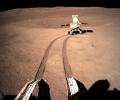
The rover will carry out in-situ chemical analysis of the lunar surface during the course of its mobility.
'China pumps in a lot more money than what we do. China's space budget is close to $5 billion while it is hardly $1 billion for us.' 'We manage the programmes within the constraints of our budget. The main difference is we prioritise.'
While the historic success of Chandrayaan-3 is celebrated by Indians across the world, two untrumpeted engineering colleges in Kerala are basking in the glory of the key role played by some of their alumni in the crucial Moon mission.

'ISRO facilities are very expensive and any damage caused by these start-ups can create havoc to our space programme.'

Top space scientist G Madhavan Nair said it may take ten years for the country to put in place such an operational rocket.

Nervous and anxious for sure but the city-headquartered space agency is cautiously optimistic of "Vikram" module's soft-landing on the Lunar surface planned in the early hours of Saturday.
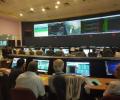
"Already, orbiter is in space and it should do an excellent job of mapping," Nair said.
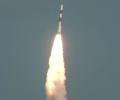
The launch marks a significant milestone for the space agency as it is the 50th flight of PSLV and the 75th vehicle mission from Sriharikota. The 628 kg satellite is meant for applications in various fields like agriculture, forestry and disaster management support. It would also serve military purposes.

In the years to come, India's space assets will play a much bigger role if and when hostilities break out on our borders, says Pallava Bagla.
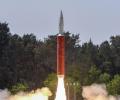
He said the country now possesses the capability to strike satellites in outer space with centimetre-level accuracy and precision.

K Sivan has to hasten the effort to bring in private players into satellite and rocket building and replicate India's software success in aerospace.
Veteran space scientist G Madhavan Nair said on Tuesday that Indian Space Research Organisation's unsuccessful bid to soft land on the moon is nothing to be alarmed about, and it would only enable the space agency master complex missions going forward.

Experts said India has possessed the anti-missile technology for several years but needed the political go-ahead to actually test it in live conditions.

'India has got a unique opportunity to get more and more business from outside as India is cost-effective and reliable.'

'ISRO's style is a terrific example of being able to survive, acknowledge failures, and then most importantly of all, learn from them to ensure that subsequent missions are successful.'
